
In 2026, we are surrounded by AI-driven security and biometric authentication. Yet, the most significant vulnerability in the digital world remains surprisingly low-tech: the human element.
Recent data from Huntress and Comparitech’s latest leak analysis—which examined over 2 billion compromised credentials—reveals a startling reality. Despite years of warnings, users are still choosing convenience over security.
The “Wall of Shame”: Top 10 Passwords of 2026
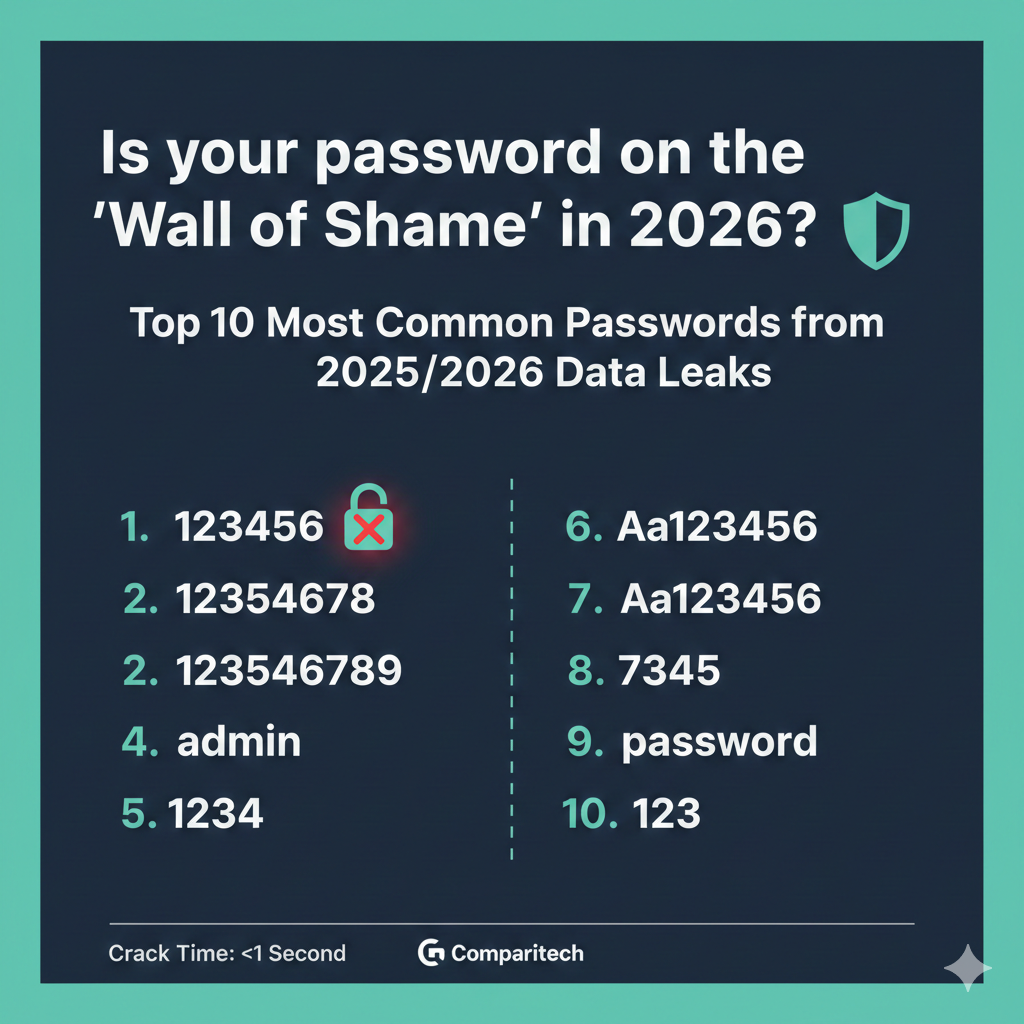
According to the latest breach data, these ten passwords appear most frequently in cyberattacks. Every single one of these can be cracked by automated tools in less than one second:
1. 123456 (The most common password globally)
2. 12345678
3. 123456789
4. admin (Often a leftover default setting)
5. 1234
6. Aa123456 (A classic attempt to bypass complexity rules)
7. 12345
8. password
9. 123
10. 1234567890
The “Aa” Trap: The Illusion of Complexity
The presence of Aa123456 at number six is particularly telling. It shows that users are trying to satisfy system requirements (one uppercase, one lowercase, and numbers) without actually increasing security. To a brute-force bot, this is just as easy to crack as “123456.” It satisfies the letter of the law but ignores the spirit of security.
How Attackers Exploit These Choices
Hackers don’t always “break” into systems; they often just “log in.” Here is how they do it:
• Password Spraying: Attackers try one common password across thousands of accounts at once to avoid being locked out.
• Credential Stuffing: Using passwords leaked from one site to gain access to others where users have reused the same login.
• Brute Force: Using high-speed software to guess every common combination until they hit a match.
Our Recommendations: Strengthening Your Defense
To protect your personal and professional data, we recommend adopting these modern standards:
• Prioritize Length Over Complexity: A 16-character passphrase like Blue-Ocean-Sky-99! is much harder to crack than a short, complex one like P@ss1!.
• Use a Dedicated Password Manager: Eliminate the need to memorize unique passwords for every site. Let a secure vault do the work.
• Mandatory Multi-Factor Authentication (MFA): Ensure that even if your password is leaked, your account remains secure through a second verification step.
• Change Default Credentials: Always update “admin” or “guest” passwords on new devices or software immediately upon installation.
The Bottom Line: A weak password is like a high-end security door left wide open. All the encryption in the world can’t save an account if the key is “123456.”